

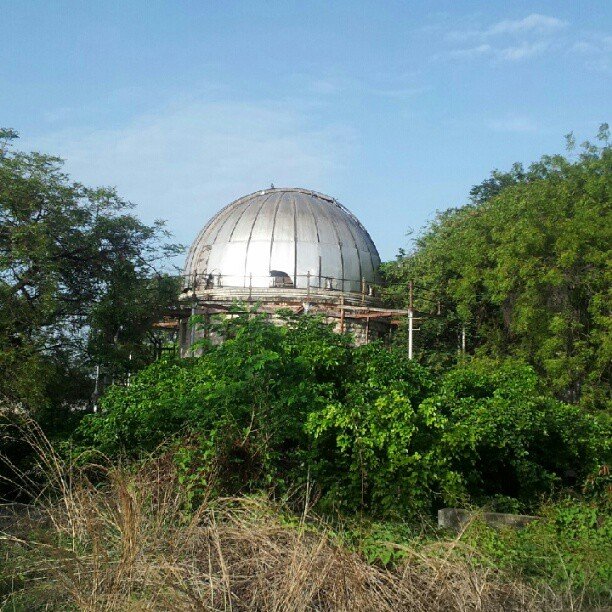
From the Hyderabad archive | Original event date: 1908
Hyderabad’s Nizamiah Observatory came under the administration of the Nizam’s government in 1908. It grew from Nawab Zafar Jung’s private observatory in Begumpet. Under Arthur B. Chatwood, who was appointed in 1908, it began preparing for a photographic survey that would connect Hyderabad’s observations with work at other observatories.
What changed in 1908?
The government took over after Zafar Jung’s death in 1907. The Indian Institute of Astrophysics’ historical account distinguishes the private observatory from the institution that began its government phase in 1908. This helps explain why the earlier work in Begumpet and the later formal milestone both appear in histories of the observatory.
How did Hyderabad contribute to the sky survey?
The international Carte du Ciel programme divided the sky into bands to be photographed by observatories with comparable instruments. Hyderabad initially took a southern band from about 17 to 23 degrees south of the celestial equator. Its eight-inch Cooke astrograph, a telescope made for taking photographs, was installed by the end of 1909. Photographic plates allowed staff to measure star positions after an exposure, and the results became part of published catalogues.
Who continued the work?
After Chatwood, R. J. Pocock and T. P. Bhaskaran carried the survey forward. Hyderabad later took on part of a northern band originally assigned to Potsdam. The observatory eventually came under Osmania University. Its dome in Begumpet links today’s neighbourhood to a period when Hyderabad supplied observations for a catalogue assembled across continents.
Archive photograph of the Nizamiah Observatory in Begumpet, taken on 4 July 2012. ShashiBellamkonda via Wikimedia Commons, CC BY 2.0.

A city worth understanding.
Continue exploring the news ↗